
6G洞见 | Tony Quek:6G通感算智融合新风口,低空经济与物理AI率先规模化
将于2026年4月21-23日在南京召开的2026全球6G技术与产业生态大会,继续汇聚全球顶尖学术力量与产业先锋,围绕多个精彩核心板块全面展开,持续推动6G关键技术的前沿探索与成果落地。
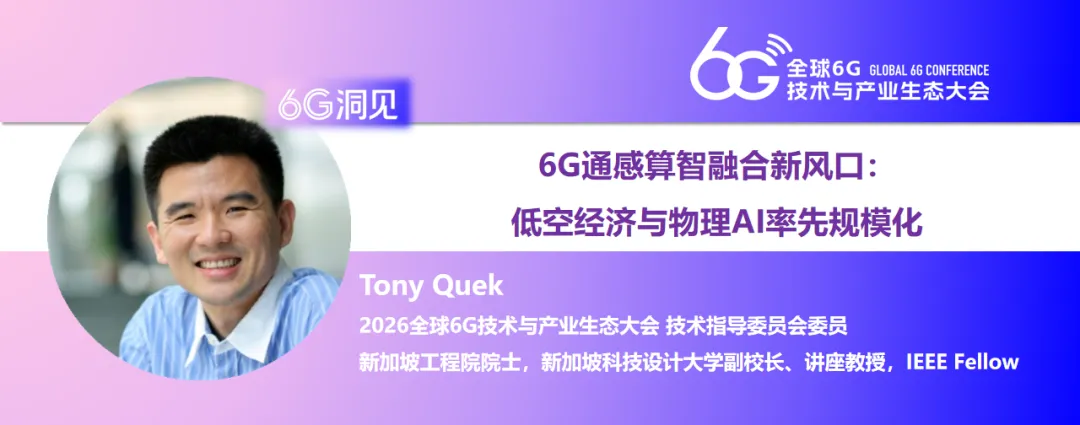
大会前夕,2026全球6G技术与产业生态大会技术指导委员会委员、新加坡工程院院士、新加坡科技设计大学副校长Tony Quek参与了【6G洞见】访谈。他重点提到,在未来3–5年内,低空经济和物理AI将成为6G通感算智融合最有可能率先实现规模化落地的两大核心应用场景。这两类场景天然需要感知、通信、计算、控制与智能的深度融合,从而支撑大规模部署在经济性与可持续性方面的可行性。
Tony Quek :The technology bottleneck will be AI-native network architecture. This architecture will be completely different from 5G as it needs to be cloud-native, AI-native and green-native. As AI technologies are evolving at tremendous fast pace, this AI-native architecture needs to open and allows easy adoption of latest AI technologies seamlessly. Firstly, the telecom industry needs have a mindset change that the 6G network will need to be able to accommodate changes in the AI industry and the ability to integrate latest AI technologies seamlessly into the 6G network. Secondly, the mindset to innovate and monetize creatively by leveraging AI-native network through new technologies like agentic AI and token economy.
技术瓶颈将体现在AI原生网络架构上。6G原生架构将与5G通信完全不同,因为它需要同时具备云原生、AI原生和绿色原生的特性。随着AI技术以极快的速度发展,这种AI原生架构需要保持开放性,并能够无缝地轻松接纳最新的AI技术。首先,电信行业需要转变思维方式,6G网络必须能够适应AI产业的变化,并具备将最新AI技术无缝集成到6G网络中的能力。其次,需要树立一种创新和商业化的思维,通过利用AI原生网络,并结合诸如代理式AI和代币经济等新技术,实现创造性的价值变现。
Q2:AI 已成为 6G 的内生能力,在网络架构、资源调度、业务感知、安全可靠等方面,AI 将如何真正驱动多要素融合?如何避免 “为 AI 而 AI”,让技术真正落地?
Tony Quek:As mentioned, AI-native network architecture will be the key to allow integration and seamless adoption of new technologies along the way. This will ensure the telecom industry can truly monetize with their investment of AI-native network. One important factor is to truly understand how to bring computing, communications, sensing, and control into one and yet able to accommodate distributed deployment.
To truly drive multi-element convergence, AI must be embedded into the network from the beginning, acting as a cross-layer intelligence engine that orchestrates spectrum, computing, sensing, and energy resources—not just optimizing isolated functions. Avoiding “AI for AI’s sake” requires a value-driven approach. AI should focus on complex scenarios such as industrial automation, low-altitude economy, and embodied intelligence, where it can deliver measurable gains in latency, efficiency, reliability, and cost. Finally, distributed AI across cloud, edge, and device, combined with open and evolvable architectures, is essential. The success of AI in 6G will be defined not by the number of models deployed, but by its ability to improve network efficiency and create real business value.
AI将成为6G的内生能力,其关键在于AI原生网络架构,使计算、通信、感知与控制实现一体化融合,并支持分布式部署。要真正驱动多要素融合,AI必须从一开始嵌入网络架构与运行体系中,作为跨层智能中枢,统一调度频谱、算力、感知与能耗等资源,而不仅是优化单点功能。同时,避免“为AI而AI”的关键在于价值导向。AI应聚焦工业自动化、低空经济、具身智能等复杂场景,解决传统方法难以应对的问题,并在时延、能效、可靠性和成本等方面带来可量化提升。此外,AI需要支持云-边-端协同的分布式部署,并依托开放架构实现持续演进。最终,AI的成功不在于使用多少模型,而在于是否真正提升网络效率并创造商业价值。
Q3:6G 多领域跨界融合会带来跨行业、跨标准、跨主体的协同难题,您认为产学研用应建立怎样的创新路径与合作模式,才能真正打通融合之路?
Tony Quek:The value of academic institutions is to serve as a platform to explore new technologies, to test new technologies, to integrate new technologies, and to drive new technologies in consortiums. In this way, they will serve as a frontline for industry to understand and fine tune their own research roadmap. Based on this understanding, academic institutions need to select their 6G research problems carefully so that they serve this purpose for industry. In particular, AI technologies are evolving at tremendous speed and there will be many different pathways and proposed AI-native architecture in the world. With this understanding, the academic institutions should be exploring the different proposals and this will help the industry significantly. I believe that this mutual understanding and partnership will ensure that the research partnership between academic institutions and industry is both fruitful and impactful.
学术机构的价值在于充当一个平台,用于探索新技术、测试新技术、集成新技术,并在联盟中推动新技术的发展。通过这种方式,它们将成为产业界了解并不断优化自身研究路线图的前沿阵地。
基于这一认识,学术机构需要谨慎选择其6G研究问题,从而更好地服务于产业发展的需求。尤其是,AI技术正以极快的速度演进,全球范围内将出现多种不同的发展路径以及AI原生架构方案。在这种背景下,学术机构应积极探索这些不同的方案,这将对产业界产生重要的推动作用。这种相互理解与合作关系将确保学术机构与产业之间的研究合作既富有成果,又具有深远影响。
Q4:面向未来 3-5 年,您认为 6G通感算智融合最有可能率先规模化落地的应用场景是什么?这些场景将给工业、民生、低空经济等领域带来哪些颠覆性改变?
Tony Quek:I believe that the low-altitude economy and physical AI will be the two most promising large-scale application scenarios for 6G integrated sensing, communication, computing, and intelligence in the next 3–5 years. Both scenarios inherently require the seamless convergence of sensing, communications, computing, control, and intelligence, which is essential to enable scalable, economically viable, and sustainable deployment. These applications will bring transformative impacts across industries. For example, in industrial and embodied intelligence scenarios, they will enable real-time closed-loop control and autonomous operations. In the low-altitude economy, they will support safe, efficient, and large-scale coordination of drones and aerial systems, fundamentally reshaping logistics, transportation, and urban management.
Within this evolution, AI-RAN will play a critical role as the foundation of 6G networks, while the token economy may significantly reshape how users and devices interact with the network, opening new pathways for monetization through token networks and token-as-a-service models. At the same time, with the rapid emergence of edge intelligent terminals, pushing AI capabilities down to the radio access network (RAN) becomes increasingly important, especially for industrial IoT, low-altitude systems, and embodied AI. This trend is driving a deeper convergence of AI and communications, bringing open, open-source, and programmable architectures such as Open RAN back to the center stage.
In this context, I have also founded a startup in China focusing on AI-native RAN systems and platforms, along with edge computing accelerator cards. These innovations are designed to enable richer edge AI applications with faster response, lower power consumption, and stronger privacy protection, for example through local or private network deployment of large models.
在未来3–5年内,低空经济和物理AI将成为6G通感算智融合最有可能率先实现规模化落地的两大核心应用场景。这两类场景天然需要感知、通信、计算、控制与智能的深度融合,从而支撑大规模部署在经济性与可持续性方面的可行性。这些应用将对多个领域带来颠覆性影响。例如,在工业和具身智能场景中,将实现实时闭环控制和自主运行能力;在低空经济领域,将支撑无人机及各类空中系统的安全、高效、大规模协同运行,从而重塑物流、交通以及城市治理模式。
在这一演进过程中,AI-RAN将成为6G网络的重要基础,而代币经济有望显著改变用户与网络之间的交互方式,并为电信行业通过代币网络和“代币即服务”模式开辟新的商业变现路径。与此同时,随着边缘智能终端的快速涌现,将AI能力下沉至无线接入网(RAN)侧变得愈发关键,尤其是在工业物联网、低空系统以及具身智能等场景中。这一趋势正在推动AI与通信的深度融合,使开放、开源、可编程的网络架构(如Open RAN)重新成为行业关注的核心。在此背景下,我也在国内创立了一家初创公司,专注于研发AI原生的AI-RAN系统与平台以及边缘算力加速卡。这些技术旨在支持更加丰富的边缘AI应用,实现更快的响应、更低的功耗以及更强的隐私保护能力,例如通过本地部署或专网环境部署大模型。